
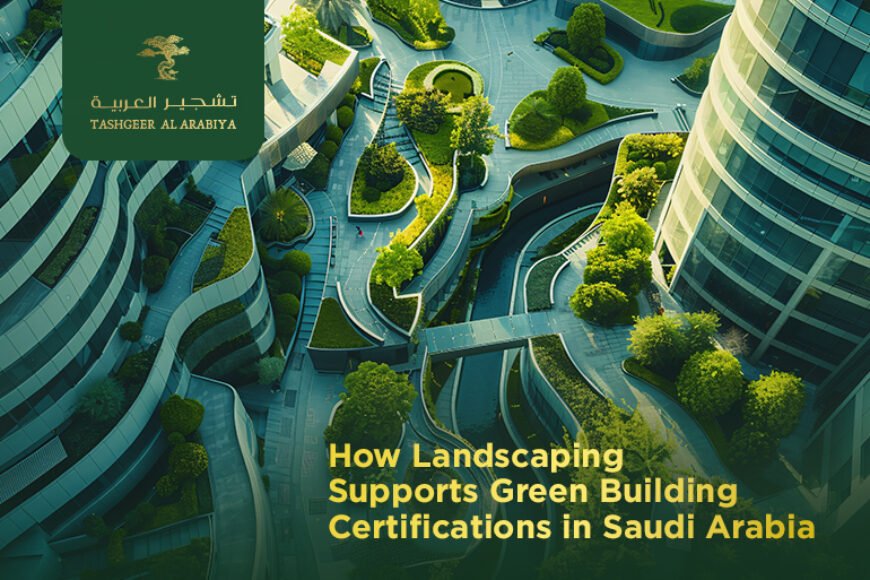
How Landscaping Supports Green Building Certifications in Saudi Arabia
- April 27, 2026
- 0 Comment
Green building certifications are no longer a niche interest in Saudi Arabia — they’re becoming a mainstream expectation. As Vision 2030 drives the Kingdom toward sustainability, more developers, architects, and homeowners are pursuing certifications like LEED, GSAS, and Mostadam to validate their environmental commitments.
What many people don’t realise is that landscaping plays a significant role in achieving — and maintaining — these certifications. Green building landscaping Saudi isn’t just about planting trees and calling it green. It’s a strategic, science-based approach to outdoor design that contributes measurable points toward certification scores and genuine environmental outcomes.
At Tashgeer Al Arabiya, we are well-versed in the landscape requirements of Saudi Arabia’s main green building frameworks. Here’s what you need to know.
The two most relevant green building certifications in the Kingdom are:
All three systems include categories where landscaping decisions contribute directly to the certification score.
In any green building framework, water is a critical issue in Saudi Arabia — and green building landscaping Saudi projects that demonstrate water efficiency gain significant certification credit.
Landscaping strategies that contribute to water credits include:
At Tashgeer Al Arabiya, we routinely design irrigation systems that reduce water consumption by 50% or more compared to conventional systems — a substantial contribution to any eco projects KSA certification application.
Urban heat islands are a significant issue in Saudi Arabia’s cities. Dark paved surfaces, lack of vegetation, and dense building create pockets of intense heat that drive up cooling energy consumption. Sustainable construction landscaping helps counteract this.
Landscape strategies that earn heat island reduction credits:
For green building landscaping Saudi projects, demonstrating measurable heat island reduction is one of the most impactful contributions a landscape can make.
GSAS and LEED both contain credits for biodiversity and ecological value. This includes:
This is an area where Saudi Arabia has a rich native palette to draw from — from ghaf trees to desert grasses and native shrubs that support pollinators and birds.
The materials used in green building landscaping Saudi projects also affect certification scores. Using locally sourced materials, recycled content, and low-VOC products all contribute to material credit categories.
Examples include:
While Saudi Arabia’s rainfall is limited, when it does rain — especially in events like the flash floods that have affected Jeddah and Riyadh — effective stormwater management becomes critical. Green building frameworks reward landscapes that manage stormwater on-site.
Sustainable landscaping strategies for stormwater management:
Trees and shrubs absorb carbon dioxide and store carbon in their biomass and the soil. While landscaping alone won’t offset a building’s carbon footprint, a well-planted site contributes meaningfully to carbon sequestration — and demonstrates commitment to eco projects KSA goals. For maximum impact, green building landscaping Saudi projects should prioritise large, long-lived trees that will accumulate significant carbon over their lifespans.
One area where professional landscaping support is invaluable for green building projects is documentation. Certification bodies require detailed evidence of every sustainability claim — irrigation schedules, plant species lists, material sources, stormwater calculations, and more.
At Tashgeer Al Arabiya, we provide comprehensive documentation for all sustainable construction landscaping projects, ensuring our clients have everything they need for a smooth certification process.
Beyond certification points, green landscaping makes strong financial sense. Water savings, reduced maintenance costs, higher property values, and tenant attraction all contribute to a compelling ROI for developers and homeowners who invest in sustainable outdoor design.
Planning a green building project in Saudi Arabia? Tashgeer Al Arabiya is your landscape partner for certification success. Contact us today at tashgeer-sa.com to discuss how we can help your project achieve its sustainability goals.
