

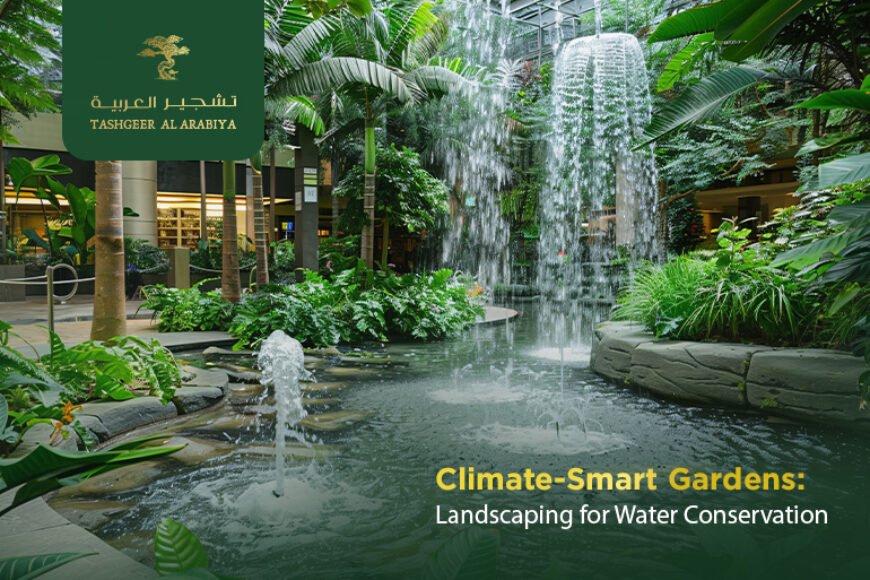
Climate-Smart Gardens: Garden Design Landscaping for Water Conservation
- مارس 4, 2026
- 0 Comment
Water scarcity is a growing concern. Traditional lawns consume excessive water and require heavy maintenance.
• Reduce water usage
• Lower costs
• Increase resilience
• Support biodiversity
Forward-thinking professionals embrace water-wise principles not as compromise but as opportunity. We create landscapes more beautiful, resilient, and appropriate to their place than conventional designs ever achieve—perfect for residential villas, commercial properties, and public spaces throughout the region.
Xeriscaping represents a systematic approach to water-wise design that many people misunderstand as synonymous with cactus gardens and gravel.
In reality, xeriscaping encompasses seven principles that reduce water use while maintaining beauty and functionality.
Xeriscaping follows seven principles:
1. Proper planning
2. Soil improvement
3. Appropriate plant selection
4. Practical turf reduction
5. Efficient irrigation
6. Mulching
7. Smart maintenance
These principles create gardens ranging from desert-style landscapes with succulents and stone to lush, green spaces featuring drought-tolerant perennials, grasses, and even lawn alternatives.
Our certified landscape professionals with expertise in xeriscaping, develop customized designs that reduce water consumption without compromising visual appeal. From homes to commercial and public spaces, conservation and elegance work together seamlessly.
Plant selection forms the cornerstone of successful water-conserving design, though suitable choices vary dramatically based on your specific region and microclimate.
• Mediterranean herbs
• Native grasses
• Succulents and agaves
• Olive trees
• Lavender and rosemary
• Perennial groundcovers
We recommend species that truly thrive in our specific conditions, whether for residential villas, commercial properties, or public landscapes.
Soil quality fundamentally determines how successful your water-conserving design becomes, yet many people skip this crucial foundation step.
Healthy soil retains moisture efficiently. Compost and organic matter improve both clay and sandy soils.
Proper soil preparation before planting pays dividends for the entire life of your garden. Trying to correct poor soil after plants are established proves far more difficult and expensive.
Drip irrigation, zoning, rainwater harvesting, and smart controllers significantly reduce waste.
Traditional turf grass ranks among the thirstiest, most maintenance-intensive elements in conventional design. It consumes vast amounts of water, fertilizer, pesticides, and weekly mowing throughout the growing season.
• Native groundcovers
• Creeping thyme
• Clover blends
• Ornamental grasses
• Mulched areas
Reduce lawn to only essential functional spaces.
Resilient design plans proactively for dry periods rather than reacting in crisis mode when restrictions hit.
• Deep plant establishment
• Fresh seasonal mulch
• Reduced fertilization
• Smart irrigation adjustments
Natural advantages:
Many drought-adapted plants actually look their best during dry seasons. They come into their own when conventional gardens struggle.
Ready to create a water-efficient garden design landscaping? Contact us for a sustainable design consultation. Our team specializes in sustainable design for residential properties, commercial landscapes, and public spaces throughout the region.
